
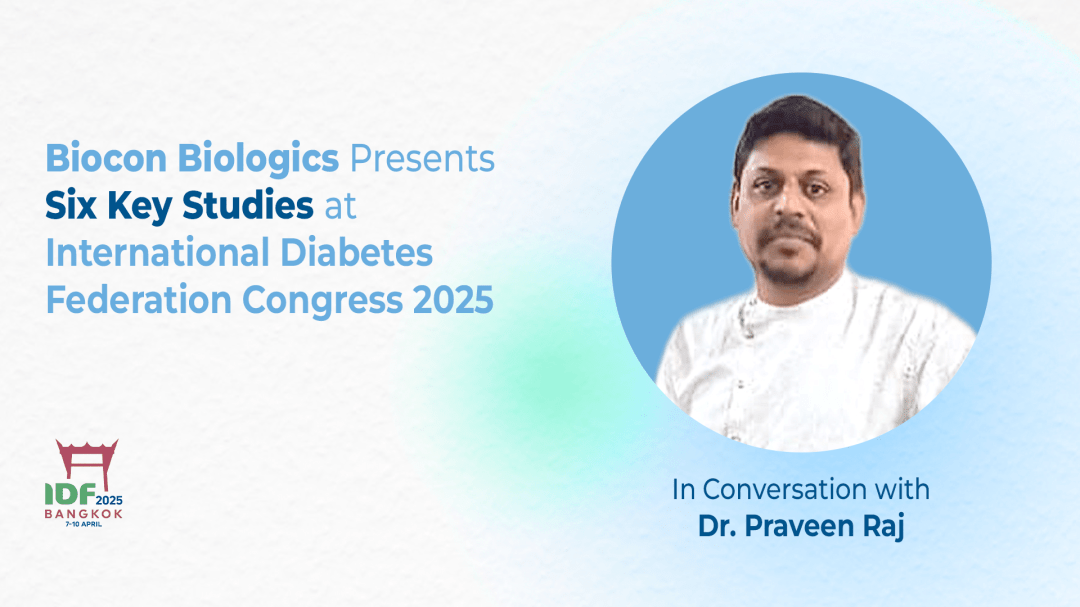
Today, we have a special conversation with Dr. Praveen Raj, Head of Medical Affairs, who recently represented Biocon Biologics at the prestigious International Diabetes Federation (IDF) Congress. IDF is a global platform where researchers, clinicians, and industry leaders from around the world share the latest advancements in diabetes care.
This year, Biocon Biologics presented six significant studies on biosimilar insulins, reinforcing our commitment to affordable and accessible diabetes care.
In this conversation, Dr. Praveen, a co-author of all the posters, shares insights into these studies and their impact.
What is the IDF Congress, and why is it such an important event in the diabetes community?
The International Diabetes Federation (IDF) is the global voice of the diabetes community, encompassing 240 national diabetes associations in 161 countries and territories. The IDF 2025 Congress discusses advancements in diabetes care, prevention, and research. It features 130 hours of scientific sessions, 250 leading international speakers, and an 8,000 m² exhibition. More than 6,000 delegates worldwide had gathered this time at IDF.
What does it mean for Biocon Biologics to present at IDF? How does it reinforce our leadership in diabetes management?
In 2025, Biocon Biologics presented 6 research abstracts at the IDFfor the first time. This showcases our efforts in making a meaningful contribution in tackling diabetes globally. These studies were not only being presented to an international community of healthcare professionals and experts but will also be published in the IDF official journal i.e Diabetes Research and Clinical Practice (DRCP). DRCP is an indexed journal with a high impact factor and is well-regarded for its rigorous peer-review process, publishing high-quality research articles and expert reviews.
I understand that Biocon Biologics is presenting six posters this year. Can you share when these studies were conducted and what their focus areas were?
Indeed! These studies were conducted in the last 2-3 years in multiple geographies. The emphasis of each study was different. For example:
- The SWITCH / SOLID study (India) provided real-world evidence on how biosimilar insulins improved effectiveness and safety in people with diabetes.
- BIGGER study (Czech Republic) focused on the human factor elements of the Insulin Glargine (Semglee®) pen.
- 10 cent Insulin Initiative (Philippines) focused on how an integrated ecosystem in diabetes improved clinical outcome and enhanced adherence.
How long do these clinical studies usually run in a real world (RWE) setting?
RWE studies typically run for a duration of –2-3 years. This includes multiple phases: conceptualisation, study design, protocol, investigator meetings, study conduct, analysis, outcome, and publication. These phases are essential to ensure the depth and reliability of insights drawn from real-life clinical settings.
Who were the key people involved in presenting these study findings at the conference?
These studies were possible through collaborative efforts of several clinicians, globally. The key investigators involved in this study were:
| Dr. Denisa Janickova, Charles University and Military Hospital, Prague |
| Dr. Robert Bem, Institute for Clinical and Experimental Medicine, Prague |
| Dr. Banshi Saboo, Chair Elect – IDF South East Asia |
| Dr. A K Das, Prof. Emeritus Endocrinology MGMCRI, India |
| Dr. B M Makkar, Hony Secretary – AIAARO and Course Director – Cleveland Clinic Advanced Certificate Courses in Diabetes, India |
What are the key insights from these studies in terms of safety, efficacy, and affordability of Biocon Biologics’ biosimilar insulins?
Sure, I would be happy to summarise the study outcomes.
BIGGER I & II Study: Involving over 1,100 people in the Czech Republic, these studies looked at the ease of usability of Insulin Glargine (Semglee®) pens. The study found that the Semglee® pen was easier to feel and hear when setting doses, smoother to use, and simpler to learn how to use. Overall, users expressed more satisfaction, an important indicator in helping patients adhere to treatment regimen, especially for chronic diseases like diabetes.
SOLID Study: This study involved 250 patients with diabetes mellitus and evaluated the impact of the Patient Support Programs (PSP) on glycemic control and quality of life. Results indicate that those who participated in the program reported a significant improvement in HbA1c levels and the quality of life compared to those who did not.
Philippines Integrated Ecosystem: The study aimed to demonstrate the integrated ecosystem that can improve diabetes outcomes. Through our “10 cents” insulin initiative, people living with diabetes in the Philippines were able to get doorstep delivery of insulins rather than visiting a clinic or hospital. This enabled patients to remain adherent to treatment, thus having a positive improvement in HbA1c levels. The study highlights that a combination of support and access can make a significant difference in diabetes management.
What impact do you see this work will have on global diabetes management, particularly in terms of access and affordability?
In the constantly evolving world of medicine, research plays a key role in helping doctors and healthcare experts make informed decisions. A good patient experience goes beyond just safety and effectiveness, it also includes how easy a treatment is to use, how affordable it is, and whether it improves quality of life. These factors are just as important and help encourage the use of biosimilar insulins. As a result, more patients can access the care they need, supporting the long-term strength and sustainability of healthcare systems worldwide.
Looking ahead, what’s next for Biocon Biologics in terms of biosimilar insulin research and advancing patient outcomes?
At Biocon Biologics, we believe real-world evidence plays a crucial role in enhancing diabetes management. This approach helps in multiple ways: by identifying gaps in treatment efficacy, patient’s pain points, addressing medication adherence issues, and ensuring that patient care strategies are data-driven. Leveraging RWE will be essential for developing effective management strategies that will be a true reflection of real-world challenges and patient needs. Healthcare systems can strive to achieve better health outcomes by focusing on these factors. The key impact would be on:
- Improving medication adherence.
- Guiding clinical decision-making.
- Shaping policies and guidelines.
All the above will enable better treatment outcomes.
Thank you, Dr. Praveen, your insights are truly valuable. It is inspiring to see how Biocon Biologics is making a difference in diabetes care and enhancing patient lives through scientific research and affordable access.


